
Thousands of people living in Japan take a part-time convenience store job and never talk about it publicly. That's a gap worth filling.
FamilyMart runs over 16,000 stores across Japan as of 2026. Somewhere near you, there is probably a shift available right now.


I think the appeal here gets undersold. A FamilyMart part-time job is one of the fastest ways a foreigner or newcomer can build actual, spoken business Japanese while earning money at the same time.
This guide is for people already in Japan, or seriously planning to be. If you want real information about what the work looks like, what you need, and what nobody warns you about, keep reading.
What Kind of Work Actually Happens at FamilyMart
The job title is "arubaito," the Japanese term for part-time work. Most people picture someone ringing up onigiri and handing back change. That is part of it. But the full picture is wider.
The Four Main Roles You Will Likely Rotate Through
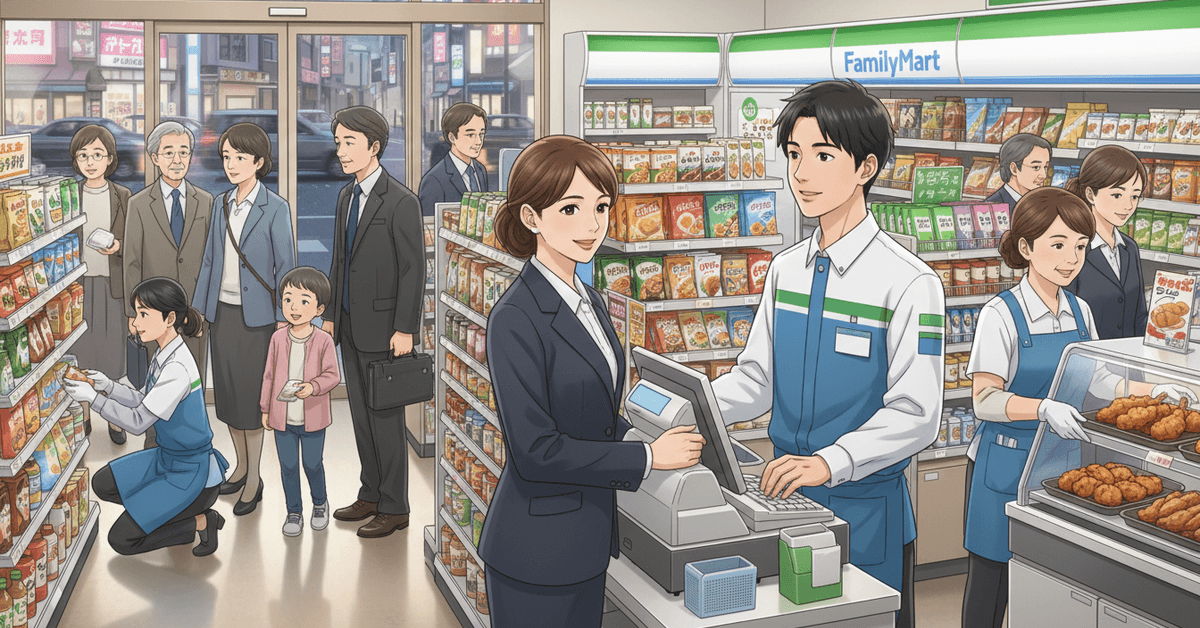
Front counter work is the core of every shift. Greeting customers, scanning items, processing payments, and handling campaign promotions like loyalty stamps or app tie-ins.
Stock shelving and product rotation happens constantly. Drinks, snacks, and ready-to-eat meals all have expiry windows. Checking dates and rotating stock is part of every shift, not just a backroom task.
Food prep for hot items applies at stores selling fried chicken or steamed buns. You follow health protocols, prepare the items, and keep the display stocked. It is more involved than it sounds.
Cleaning and store upkeep rounds out the shift. Trash disposal, floor maintenance, restocking bathroom supplies. It is repetitive work, but skipping it creates problems fast.
One Thing Worth Noting About Role Rotation
FamilyMart does not usually hire you for one specific task. You cycle through all of the above. On some shifts, you will do all four. This is worth knowing ahead of time if you were expecting a narrow job description.
Pay, Hours, and Shift Options
How Much FamilyMart Actually Pays
Hourly wages vary by region and year. Japan's minimum wage differs by prefecture, and FamilyMart tends to pay at or slightly above the local minimum.
Late-night and early-morning shifts often include a shift premium, sometimes called "midnight allowance" or 深夜割増 (shinya warimashi). After a probation period, some staff report small raises.
I'd be direct about this: the pay is not high by global standards. But for someone building language skills and needing flexible hours, the trade-off can make sense.
Shift Options for Real People's Schedules
FamilyMart stores run 24 hours. Shifts are generally broken into:
- Morning shifts (early commuter rush, 6am-12pm range)
- Afternoon shifts (midday to evening, lower volume but consistent)
- Evening/night shifts (after 10pm, shift premium applies, lower foot traffic)
The flexibility here is real. Students at language school, parents working around childcare, and people running side income streams all work these jobs. The scheduling tends to be negotiated directly with the store manager, not a corporate system.
Requirements: What You Actually Need to Apply
Age and Visa Status
Applicants generally need to be 18 or older. For foreigners, a valid working visa or a student visa with permission to work part-time is required.
Student visa holders are limited to 28 hours per week under standard rules. During designated school holiday periods, that cap may increase, but only with updated official permission. Do not assume the holiday exception applies automatically.
Japanese Language Skills
This is where I genuinely disagree with the common advice that "basic Japanese is enough." I think framing it that way sets people up for a frustrating first month.
Customer-facing convenience store work requires you to understand fast speech, local accents, and indirect requests.
A customer asking you to heat something or helping a confused delivery driver is not a textbook exchange. I'd say intermediate conversational Japanese is a more honest target before starting, not beginner-level.
That said, managers at some locations are patient with learners, and consistent improvement goes a long way.
What Else Managers Look For
- Punctuality. Shift overlap is slim. Arriving five minutes late leaves the outgoing employee stuck.
- Reliability. Short-notice absences cause real problems.
- Attitude toward learning. Stores train new hires, but they expect you to absorb quickly.
The Hiring Process Step by Step
How to Apply
Applications go through the official FamilyMart job portal or directly at the store. In-store applications still happen. Walk in during a slow period, ask for a paper form, and introduce yourself to the manager.
Job listings also appear on Townwork, one of Japan's largest part-time job boards, and on Indeed Japan.
What the Interview Looks Like
FamilyMart interviews are brief and practical. Expect questions about your availability, your Japanese level, and whether you have experience in customer service. There is no formal panel. It is usually one manager, maybe fifteen minutes.
Some stores run trial shifts before committing to a schedule. This is normal and benefits both sides. Do not treat a trial shift as a low-stakes day off.
What the Work Feels Like Day-to-Day
Busy Periods and Why They Matter
Morning commuter rushes (roughly 7am to 9am) and evening rushes (6pm to 8pm) are the most demanding windows. Shelves need restocking before customers arrive, not during the rush.
Delivery trucks arrive regularly. Unpacking fresh stock quickly is part of keeping things running.
The Unexpected Part of the Job
A FamilyMart employee is sometimes a travel guide, a ticket vendor, an event registration desk, and a lost-and-found operator all in one shift. Customers print concert tickets, pay utility bills, and ask where the nearest train station is.
I was surprised by how wide the actual task list runs compared to what the job description implies. If you go in thinking it is just a cashier job, the first week will feel chaotic.
Honest Look at the Pros and Tradeoffs
What Works Well
- Flexible scheduling that adapts around school or other commitments
- Real business Japanese practice, across hundreds of customer interactions per shift
- Occasional staff discounts, depending on the specific store manager
- Exposure to Japanese retail culture and seasonal campaigns, which changes every few weeks
What Can Wear You Down
Standing for a full shift is tiring. Late-night shifts disrupt sleep patterns if you rotate them too frequently. Some customers are impatient, and language barriers add stress in high-volume moments.
That is not a reason to avoid the job. It is just an accurate picture of what the work involves.
Taxes and Legal Basics You Cannot Ignore
Part-time workers in Japan receive salary slips. If you earn above a certain threshold annually, you may need to file local income tax.
FamilyMart provides documentation. The National Tax Agency of Japan has English-language resources for workers who need guidance on filing.
For foreign residents, crossing the 28-hour weekly limit on a student visa can create visa complications. Track your hours each week. Store managers are generally aware of the rules, but the responsibility ultimately sits with the employee.
Comparison: FamilyMart vs. Other Convenience Store Chains for Part-Time Work
| Chain | Number of Stores (Japan, 2026) | Night Shift Premium | Language Support for Foreign Staff |
|---|---|---|---|
| FamilyMart | ~16,000 | Yes | Limited, store-dependent |
| 7-Eleven Japan | ~21,000 | Yes | Limited, store-dependent |
| Lawson | ~14,000 | Yes | Limited, store-dependent |
All three chains run similar part-time structures. The practical difference usually comes down to which store is closest to you and which manager you connect with during the interview.
Questions People Ask About FamilyMart Part-Time Jobs in Japan
Q: Can I apply to FamilyMart without speaking Japanese at all? Technically yes, but you will likely struggle through the first few weeks significantly. Customer-facing shifts require understanding varied speech, not just memorized phrases. Intermediate conversational Japanese is a more realistic starting point.
Q: Do I need any specific certifications or food handling licenses? A general food handler certification is sometimes required for roles involving hot food preparation. The specific requirement varies by store and prefecture. Ask during the application or interview.
Q: Can I work at FamilyMart on a tourist visa? No. Tourist visas do not permit paid work in Japan. A working visa or a student visa with work permission is the minimum requirement.
Q: Are shifts guaranteed each week, or does it vary? Scheduling depends on the store and your agreement with the manager. Some workers have fixed weekly shifts; others work on a rotating or as-needed basis. Confirm the arrangement before accepting.
Q: What happens if I exceed 28 hours per week on a student visa? Exceeding the limit is a visa violation. It can affect your ability to renew your student visa. Track your hours carefully, and do not let a manager pressure you into extra shifts beyond your legal limit.
Conclusion
A FamilyMart part-time job rewards people who show up consistently and stay curious about the work. The pay is modest, but the language exposure is unlike any classroom setting.
Anyone serious about working in Japan should treat the first month as a learning investment, not just a paycheck. The stores are everywhere, the schedules are flexible, and the experience transfers to nearly any other role in Japan's service economy.